Where to Start With Event Sustainability (Without Overhauling Everything)
Sustainability is often framed as an all-or-nothing proposition. In reality, the most effective event sustainability strategies begin with a few smart, targeted decisions. It does not require a complete operational overhaul.
If you’re wondering “What’s the smartest first step?”, this article is for you.
Why Starting Small Is Strategic (Not a Cop-Out)
Trying to “do everything” at once usually leads to one of three outcomes:
- Decision paralysis
- Last-minute compromises
- Well-intentioned choices with little real impact
A focused starting point allows you to:
- Build internal confidence
- Establish repeatable systems
- Generate measurable results you can actually explain
To help you determine your focused point, figure out your eco-values then use them as your north star. And remember that sustainability works best when it’s integrated early and scaled gradually.
The 3 Best Entry Points That Deliver Real Value
1. Start With What You Control Most
Look for areas where you already have decision-making authority. For most events, this includes:
- Venue and hotel selection
- Catering choices
- Printed materials
- Waste and signage
- Supplier requirements
These choices don’t require organizational change, just clearer criteria.
2. Focus on One Impact Area Per Event
Rather than spreading effort thinly, choose ONLY ONE sustainability priority per event:
- Location of your venue
- Prioritizing a predominantly vegetarian and vegan menu
- Material reduction and emphasizing rentals or reuse
- Eliminating single-use plastic
This creates clarity for your team and avoids token gestures.
3. Build a “Good–Better–Best” Framework
Create a chart. List the impact area in the first column. And label the following columns good, better and best. Within each impact area, list one good action you can take, then a better one and the best case scenario. Here’s an example:
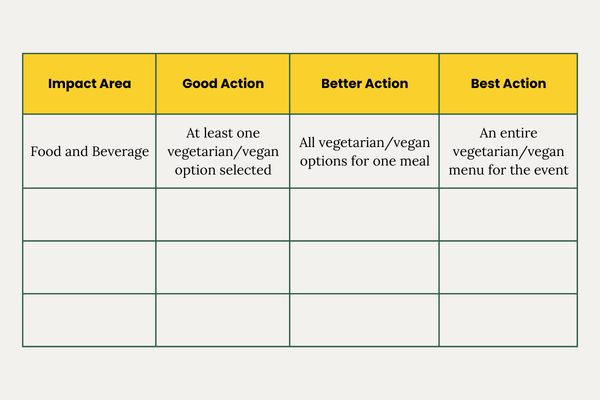
By using this approach, it:
- Keeps options realistic across different budgets
- Prevents sustainability from becoming a blocker
- Makes trade-offs transparent
It also gives you language you can reuse with clients and stakeholders.
What to Skip at the Start
Some actions sound impressive but deliver limited returns early on, such as one-off offsets without measuring the carbon footprint of your event or creating custom sustainability reports with no baseline data.
These can come later once you have either the systems in place to support them or hire the experts to manage it.
Recap
Before your next event, ask yourself (and/or your team):
- What are our eco-values?
- Do we know our biggest impact areas?
- Can we explain why we chose certain actions? (i.e. Good-Better-Best Framework)
- Are our sustainability choices repeatable?
If the answer is yes to all the above, then you’ve started in exactly the right place.
Curious what a strong first step looks like for your specific event or venue? A short audit or conversation can often reveal the clearest path forward. Book a free 20-minute discovery call here.